The Ultimate Dominica Travel Guide
The Ultimate Dominica Travel Guide for 2027
Dominica is the Caribbean destination for travelers who thought they had seen it all. Nicknamed the Nature Island, the volcanic island packs 365 rivers, nine active volcanoes, a UNESCO-protected rainforest, the second-largest boiling lake in the world, dozens of waterfalls, year-round sperm whale pods offshore, and the Caribbean's only remaining sovereign indigenous territory into a space you can drive across in 90 minutes.
Note: Dominica (pronounced dom-in-EE-kah) is a different country from the Dominican Republic. If you are looking for all-inclusive beach resorts, Punta Cana, or Sandals Barahona, you want the Dominican Republic. If you are looking for rainforest, hiking, world-class diving, whale encounters, and boutique eco-luxury hotels like Secret Bay, you want Dominica.
This InterStays pillar guide covers everything you need to plan a Dominica trip: the signature experiences, where to stay, how to get there (it is harder than other Caribbean destinations), when to visit, cost expectations, and the practical realities most travel sites skip. Use this guide as your starting point, then dive into detailed child guides linked throughout.
InterStays is a luxury Caribbean travel agency with deep ties across the region, including specialist knowledge of nature-first destinations like Dominica.
Why Dominica
Dominica is the Caribbean island that got written out of most travel brochures because it does not fit the format. There are no sprawling all-inclusive beach resorts. The beaches are mostly volcanic black sand rather than postcard white. Nothing is particularly flat. It rains more than most of the Caribbean. None of this is a problem; it is the entire point. The travelers who find Dominica almost never leave disappointed.
- 1Rainforest, not resort strip60 percent of the island is covered in rainforest. The Morne Trois Pitons National Park is a UNESCO World Heritage Site, the first natural site in the Eastern Caribbean to receive the designation.
- 2365 riversThe local saying is one river for every day of the year. Dozens of waterfalls, hot springs, and freshwater pools, including Trafalgar Falls, Emerald Pool, Middleham Falls, and Victoria Falls.
- 3Year-round sperm whalesDominica is one of the only places in the world where sperm whales can be seen year-round. The island's leeward coast is a resident pod feeding ground, and whale watching success rates are among the highest in the world.
- 4Diving above the volcanic dropScotts Head Marine Reserve, Champagne Reef (volcanic bubbles rising through the water), and the Soufriere drop-off are routinely ranked among the Caribbean's best dive sites.
- 5The only sovereign Kalinago TerritoryDominica is the only Caribbean island with a legally recognized indigenous territory. The Kalinago (historically called Carib) are the pre-Columbian people of the Caribbean, and roughly 3,000 live within the 3,700-acre territory on the east coast.
- 6Boiling LakeThe second-largest actively boiling lake in the world (after Rotorua, New Zealand). The hike to see it is one of the Caribbean's most memorable adventures.
Dominica vs the Dominican Republic
This matters, and it comes up constantly. Two completely different countries. Here is the quick clarification.
Commonwealth of Dominica
Small volcanic island in the Eastern Caribbean (Lesser Antilles), between Guadeloupe and Martinique. Population roughly 72,000. English-speaking (French Creole also spoken). Independent nation, former British colony.
- Nature, rainforest, hiking, diving, whale watching
- Boutique eco-luxury (Secret Bay, Cabrits Kempinski)
- No all-inclusive resort culture
- Volcanic black-sand beaches
- Smaller tourism scale
República Dominicana
Large country on the island of Hispaniola in the Greater Antilles, sharing the island with Haiti. Population roughly 11 million. Spanish-speaking. Home to Punta Cana, Santo Domingo, Puerto Plata.
- Mass-market all-inclusive beach vacations
- Punta Cana, Casa de Campo, La Romana
- White-sand beach destinations
- Massive tourism infrastructure
- Lower cost per night, higher volume
If you landed here looking for Punta Cana or Dominican Republic resorts, you want our Dominican Republic guide (coming soon). If you landed here looking for a quiet, nature-first Caribbean island with world-class diving and the best whale watching in the region, keep reading. You are in the right place.
Dominica at a glance
- Country statusIndependent nation (Commonwealth of Dominica)
- CapitalRoseau (SW coast)
- Main airportDouglas-Charles Airport (DOM), Marigot
- Second airportCanefield (DCF), near Roseau (limited)
- CurrencyEastern Caribbean Dollar (XCD), USD widely accepted
- LanguageEnglish (official), French Creole (Kwéyòl) widely spoken
- DrivingLeft-hand side of the road
- Time zoneAtlantic Standard Time (one hour ahead of EST in winter)
- Highest pointMorne Diablotins, 4,747 ft
- Area290 sq miles (smaller than NYC)
- Population~72,000
- Signature attractionBoiling Lake (second-largest in the world)
- UNESCO siteMorne Trois Pitons National Park
- Peak seasonMid-December to mid-April
- Hurricane seasonJune 1 to November 30 (peak Aug to Oct)
- Dialing code+1-767
When to visit Dominica
Dominica is a rainforest island. Expect more rain than other Caribbean destinations year-round. Season still matters, but it shapes experience more than it decides go-or-no-go.
| Season | Months | Weather | Prices | Best for |
|---|---|---|---|---|
| Peak dry | Mid-Dec to mid-April | Driest, sunniest, 75-82°F | Highest | First-time visitors, hiking, Boiling Lake |
| Carnival | Feb/March | Peak dry, cultural events | Peak | Jump up carnival (one of the Caribbean's most authentic) |
| Shoulder spring | Mid-April to June | Warm, occasional showers | Moderate | Value window, diving still excellent |
| Early summer | July | Warm, humid, more rain | Lower | Dive Festival mid-July, lower crowds |
| Peak hurricane | August to October | Hot, humid, highest storm risk | Lowest | Budget travel, travel insurance essential |
| Shoulder fall | November | Weather improving, World Creole Music Festival | Moderate | Festival travelers, quieter resorts |
| Whale watching peak | Nov to March | Dry season, best visibility | Peak | Whale encounters (sperm whales year-round, but best Nov-March) |
Our picks: February through April for the driest weather and best hiking conditions. Late October and early November for the World Creole Music Festival and improving weather. Mid-July for the Dive Festival.
Getting to Dominica
Getting to Dominica is harder than getting to Jamaica, St. Lucia, or Barbados. There is no major hub airport, and most routes involve a connection. This is one reason the island stays uncrowded.
Direct flights to Dominica (DOM)
- Miami (MIA): American Airlines operates seasonal direct service, roughly 3 hr 30 min.
- San Juan (SJU): American Eagle operates near-daily service, 1 hr 15 min. The most common connection for US travelers.
- Antigua (ANU): interCaribbean and LIAT (where operating) provide onward connections.
- Barbados (BGI): interCaribbean and other regional carriers.
- St. Martin / Sint Maarten (SXM): Winair, interCaribbean.
- Guadeloupe (PTP) and Martinique (FDF): Short regional flights plus the L'Express des Îles ferry.
Typical US routing
- From the Northeast: JFK, Boston, or Philadelphia to San Juan (SJU) on American, then American Eagle to Dominica.
- From the Southeast: Miami to Dominica direct (seasonal), or Miami to San Juan to Dominica.
- From the West and Midwest: Connect through Miami or Charlotte to San Juan, then onward.
- Expect a full travel day from most US gateways, with connection times built in.
Alternative: ferry from Guadeloupe or Martinique
L'Express des Îles runs regular ferry service between Dominica (Roseau) and Guadeloupe (Pointe-à-Pitre), roughly 2 hours, and between Dominica and Martinique (Fort-de-France), roughly 2 hours. Useful for travelers combining French West Indies and Dominica, or coming in from Paris via Guadeloupe.
On the ground: Douglas-Charles Airport (DOM) is on the northeast coast and roughly 1 hour from Roseau. Most resorts arrange transfers. Rental cars are available but driving Dominica's mountain roads at night is not for the inexperienced. Taxis are reliable; InterStays arranges transfers for every client.
The regions of Dominica
Dominica is small, but the regional character shifts dramatically. Here is how to think about where to base.
Roseau
The capital and largest town, on the SW coast. Historic French Caribbean architecture, the Old Market, and the launching point for most Boiling Lake hikes. Fort Young Hotel is the main in-town option. Diving access is strong from here.
Soufriere & Scotts Head
Southwestern coast, framed by a dramatic volcanic crater that forms the Soufriere-Scotts Head Marine Reserve. Champagne Reef is here. The best diving on the island. Jungle Bay Resort sits in this area.
Portsmouth & Cabrits
Northern coast around Prince Rupert Bay. Home to Secret Bay (one of the Caribbean's leading luxury resorts) and Cabrits Resort & Spa Kempinski. Access to the Indian River, Fort Shirley, and Cabrits National Park.
Kalinago Territory
East coast. The only sovereign indigenous territory in the Caribbean, home to roughly 3,000 Kalinago people across 3,700 acres and eight hamlets. Cultural experiences, Kalinago Barana Autê heritage village, and traditional craft.
Rosalie & La Plaine
East coast, Atlantic-facing. Dramatic coastline, wild surf, Rosalie Bay Eco Resort. Quieter than the west coast. Access to Victoria Falls and lesser-visited interior sites.
Morne Diablotins & the Center
The island's rainforest spine. Morne Trois Pitons National Park (UNESCO), Morne Diablotins (highest peak), the Freshwater and Boeri Lakes, and much of the Waitukubuli National Trail run through here. Not where you stay, but where you spend your days.
The signature experiences
These are the Dominica experiences that end up on nearly every traveler's list. Here is a deeper look at each.
Boiling Lake Hike
The second-largest actively boiling lake in the world (approximately 200 feet across), surrounded by the Valley of Desolation, a steaming volcanic landscape of sulfur vents and bubbling mud pools. The hike is roughly 7 miles round trip with significant elevation gain through rainforest, hot springs, and volcanic terrain. Not for casual walkers; requires fitness and solid footwear. A licensed guide is required for safety and routing.
Trafalgar Falls
Twin waterfalls (called "the mother" and "the father") that drop into a tropical rock amphitheater. A short walk from the visitor center brings you to a viewing platform. Experienced hikers can scramble to the base and swim in the pools (one is hot-spring warm, the other cold). The most accessible of Dominica's signature waterfalls.
Champagne Reef
An underwater geothermal site where volcanic bubbles rise through the water column from the sea floor, creating the visual effect of swimming through champagne. Shore-accessible for snorkelers; richer by scuba. Reefs are healthy and marine life is abundant. One of the most unique dive experiences in the Caribbean.
Sperm Whale Watching
Dominica is one of the only places in the world where sperm whales can be seen year-round. The island's leeward coast is a resident pod feeding ground, and operators report sighting success rates among the highest in the world. In certain seasons and under special permits, swim-with-whale encounters are available, though these are regulated and should be arranged well in advance.
Indian River Boat Tour
A quiet rowboat trip up the Indian River through swampy bloodwood tree roots and tropical forest. Featured in the Pirates of the Caribbean films as Tia Dalma's house location. Peaceful rather than adventurous, often ends at Cobra's Bush Bar for a rum punch. Easy half-day from Portsmouth or northern resorts.
Emerald Pool
A short 10-minute walk through rainforest to a jade-green pool fed by a 40-foot waterfall. The easiest signature nature experience on the island. Perfect first-day activity or for travelers wanting a short, accessible waterfall swim.
Victoria Falls
Dominica's most dramatic waterfall, a 160-foot cascade reached via a wet trek through the White River with multiple river crossings. The scenery is spectacular. Guide required. Less visited than Trafalgar because of the more challenging approach.
Kalinago Barana Autê
A living heritage village in the Kalinago Territory, with traditional craft demonstrations (basket weaving, canoe carving), interpretive trails, and cultural performances. Managed by the Kalinago community. The most direct way for travelers to engage respectfully with the Caribbean's indigenous heritage.
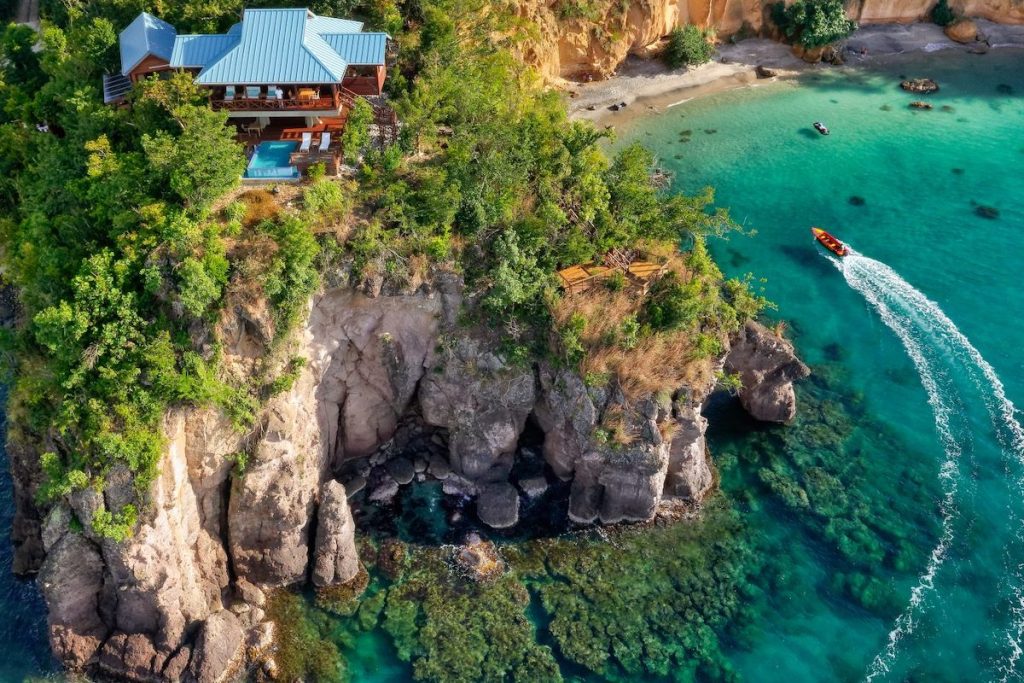
Secret Bay anchors Dominica's luxury hotel scene
Secret Bay, on the northern coast, is routinely ranked among the world's leading boutique resorts. Only a handful of villas and residences, direct ocean access, and chef-led dining. Cabrits Resort & Spa Kempinski adds a larger-footprint luxury option on Prince Rupert Bay. InterStays plans both.
Waterfalls and hot springs
Dominica has more accessible waterfalls per square mile than almost anywhere else in the Caribbean, plus volcanic hot springs scattered across the interior.
- Trafalgar Falls. Twin falls. Easy. Signature.
- Emerald Pool. Short walk to a swimmable jade pool. Easy.
- Middleham Falls. 275-foot cascade. Moderate 1-hour hike through rainforest.
- Victoria Falls. Dramatic 160-foot drop on the east coast. Moderate wet-trek.
- Sari Sari Falls. East coast. Multi-stream fall at the end of a scenic river hike.
- Jaco Falls. Quiet alternative near Dublanc. Moderate.
- Chaudiere Pool. Natural rock pool with a jumping ledge. Easy to moderate.
- Freshwater Lake & Boeri Lake. Crater lakes in the central park. Easy to Freshwater, moderate to Boeri.
Hot springs
- Wotten Waven hot springs. Multiple commercial sulfur-spring spas (Tia's, Screw's, Ti Kwen Glo Cho) in a small volcanic village. $5 to $15 entry each.
- Trafalgar hot springs. Natural pools near Trafalgar Falls, often included in a guided waterfall day.